
We had many requests for this blog following our child protection and child safeguarding article, so here it is!
We often hear the terms adult safeguarding and adult protection used interchangeably, but are they actually the same thing?
As safeguarding professionals, I think this is something we are asked frequently but at times we are challenged with asking ourselves.
Although closely connected, they do describe different aspects of keeping adults safe from abuse and neglect and understanding this distinction matters because safeguarding should never be viewed solely as something that happens when abuse has already occurred.
Effective adult safeguarding is about prevention, empowerment, promoting wellbeing, recognising risks early and creating environments where people are respected, listened to and supported to make informed choices.
In our previous article, Safeguarding vs Adult or Child Protection, we explored the broader relationship between safeguarding and protection.
Here, we take a closer look at what these concepts mean specifically for adults and how organisations can put them into practice.
What Is Adult Safeguarding?
Adult safeguarding is the wider approach to preventing and responding to abuse and neglect while promoting people's rights, wellbeing, independence and choices. The Care and Support Statutory Guidance, supporting the Care Act 2014 in England, describes safeguarding as protecting an adult's right to live safely and without abuse or neglect.
Crucially, it also emphasises working with adults to understand their views, wishes, feelings and beliefs when deciding what action to take. This means adult safeguarding is not simply about responding to incidents.
It includes:
Promoting dignity, rights and wellbeing.
Preventing abuse and neglect wherever possible.
Recognising early indicators of harm.
Supporting informed decision-making and independence.
Creating safe organisational cultures.
Ensuring people understand how to raise concerns.
Responding appropriately when abuse or neglect is suspected.
Working collaboratively with other professionals and agencies.
Learning from incidents, reviews and people's experiences.
Adult safeguarding is therefore both preventative and responsive. It should be embedded within organisational governance, policies, leadership, workforce development and everyday practice.
What Is Adult Protection?
Adult protection is commonly used to describe the more specific actions taken to protect an adult who is experiencing, or is at risk of, abuse or neglect.
It is the protective and responsive element of adult safeguarding.
Depending on the circumstances, protective action might involve:
Responding to an immediate threat to someone's safety.
Reporting suspected abuse or neglect.
Seeking emergency medical assistance or police involvement.
Making a safeguarding referral to the local authority.
Undertaking or contributing to safeguarding enquiries.
Developing a safety plan with the adult.
Taking action to prevent further abuse or neglect.
Supporting the adult to access advocacy, legal remedies or other appropriate services.
Importantly, adult protection is not a separate universal statutory process in England. The principal statutory framework for adult safeguarding is provided by the Care Act 2014, including the local authority's duty to make enquiries under section 42 when the relevant criteria are met.
The term adult protection may also be used differently in other UK nations, including within formal adult protection legislation in Scotland.
For this article, we are considering the distinction primarily within the English adult safeguarding framework.
Adult Safeguarding vs Adult Protection: What's the Difference?
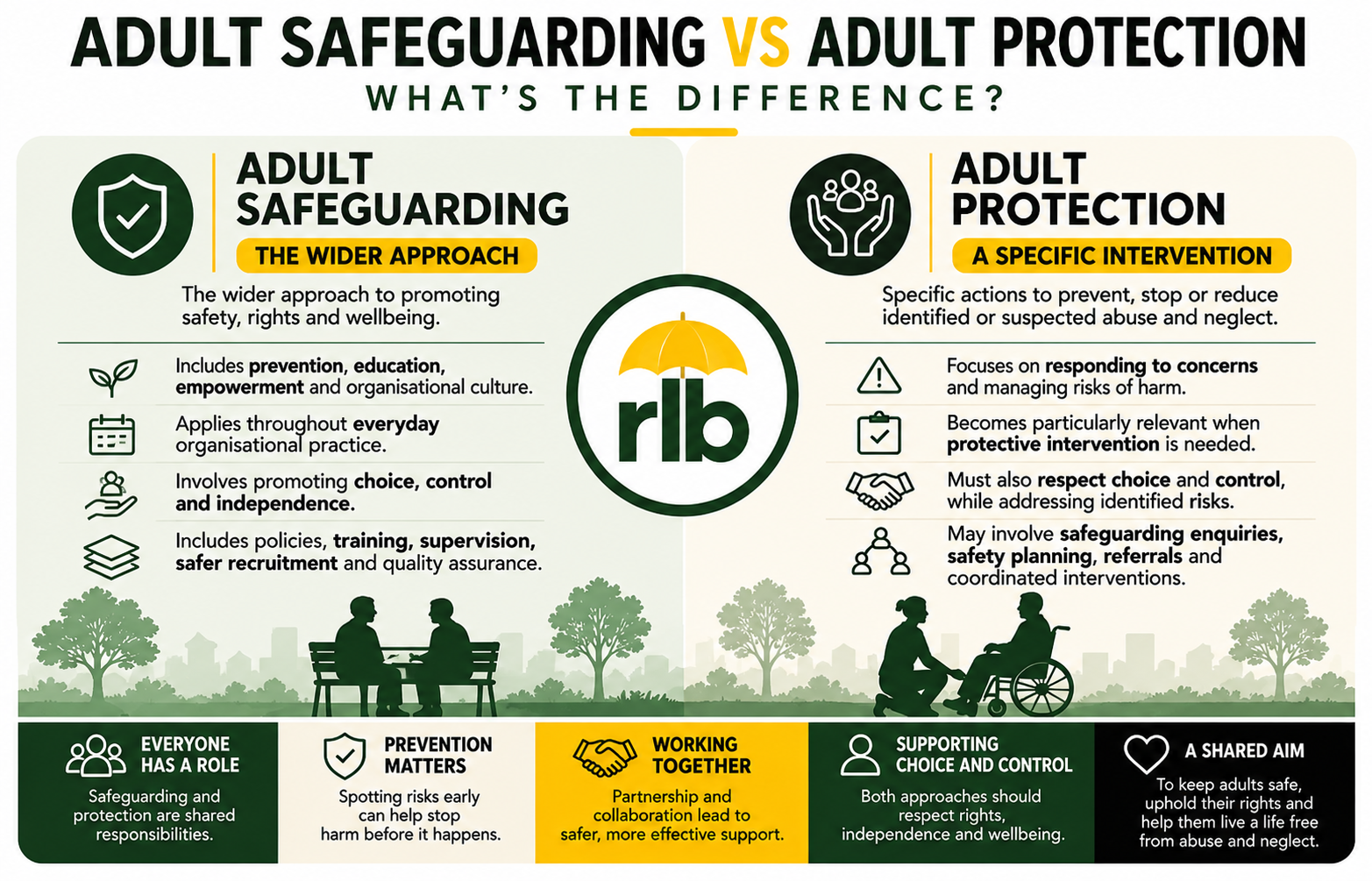
The key distinction is that adult protection forms part of adult safeguarding. It does not replace the wider responsibility to prevent harm and promote wellbeing.
What Does the Care Act 2014 Say?
Section 42 of the Care Act 2014 places a duty on local authorities in England to make enquiries, or cause others to do so, when they have reasonable cause to suspect that an adult:
Has needs for care and support, whether or not those needs are being met by the local authority.
Is experiencing, or is at risk of, abuse or neglect.
As a result of those care and support needs, is unable to protect themselves from the abuse, neglect or risk.
All three elements must be considered.
However, not meeting the section 42 criteria does not mean an organisation should simply close the concern or take no further action.
Other responsibilities may still apply, including duties relating to care and support, health and safety, equality, human rights, mental capacity, professional regulation and criminal law. Organisations should ensure that concerns are considered appropriately, even where a statutory safeguarding enquiry is not required.
A Practical Example: Safeguarding and Protection in Action
Consider an adult receiving support in a residential care setting.
Adult safeguarding in everyday practice
The organisation ensures that staff receive appropriate safeguarding training, residents understand their rights, care is person-centred and concerns can be raised safely.
Staff recognise indicators of abuse or neglect, managers provide effective oversight and residents are meaningfully involved in decisions affecting their lives.
These arrangements help prevent harm and create a safer environment.
Adult protection when a concern arises
A member of staff notices unexplained injuries and a change in the resident's behaviour. They respond appropriately, record the concern, seek any necessary immediate assistance and follow the organisation's safeguarding procedures.
The concern is considered for referral to the local authority, and appropriate protective measures are explored with the adult. Depending on the circumstances, other agencies may become involved.
These actions form part of the protective response, both approaches are essential.
A good safeguarding culture may help prevent abuse from occurring, but organisations must also be equipped to respond effectively when concerns arise.
Why Making Safeguarding Personal Matters
One of the most important principles within adult safeguarding is that people should be involved in decisions affecting their safety and wellbeing.
This is central to Making Safeguarding Personal.
Safeguarding should not automatically mean professionals taking control or making decisions on behalf of an adult. Instead, practitioners should seek to understand what the adult wants to happen, what outcomes matter to them and how risks can be managed proportionately.
This includes recognising that adults with mental capacity may make decisions that professionals consider unwise. The Mental Capacity Act 2005 makes clear that an individual must not be treated as unable to make a decision merely because they make an unwise decision. Where capacity is in question, professionals must apply the relevant legal framework and consider the specific decision involved.
There will also be circumstances where wider risks, criminal offences or duties to protect others require action. The important point is that adult safeguarding must balance protection with empowerment, rather than treating them as competing objectives.
The Six Principles of Adult Safeguarding
The Care and Support Statutory Guidance identifies six principles that should underpin adult safeguarding practice:
Empowerment: Supporting people to make their own decisions and give informed consent.
Prevention: Taking action before harm occurs.
Proportionality: Ensuring responses are appropriate to the level of risk.
Protection: Providing support and representation for those in greatest need.
Partnership: Working collaboratively with individuals, communities and relevant agencies.
Accountability: Ensuring responsibilities and decision-making are clear and transparent.
These principles demonstrate why adult safeguarding cannot be reduced to responding to incidents. Protection is one principle within a much wider framework.
Why This Distinction Matters for Organisations
When safeguarding is viewed only as a response to abuse, organisations risk overlooking opportunities to prevent harm.
They may focus heavily on referral procedures while giving less attention to organisational culture, staff confidence, early warning signs, professional curiosity and the experiences of people using services.
An effective safeguarding framework should therefore ask two equally important questions:
How are we preventing abuse and neglect?
And:
How effectively do we respond when concerns arise?
This is relevant across health and social care, housing, charities, education, community organisations and other sectors where staff or volunteers may encounter adults experiencing abuse or neglect. Although organisations' statutory responsibilities differ, everyone should understand their role in recognising concerns and taking appropriate action.
Five Questions for Safeguarding Leaders
Does our safeguarding framework give sufficient attention to prevention, rather than focusing predominantly on referrals and incidents?
Do staff understand the difference between raising a safeguarding concern and the local authority's statutory section 42 responsibilities?
Are adults meaningfully involved in decisions about their safety and desired outcomes?
Do our policies clearly explain how concerns are escalated, including when statutory safeguarding thresholds are not met?
Can we demonstrate that our safeguarding arrangements promote safety, dignity, independence and wellbeing in everyday practice?
Final Thoughts
Adult safeguarding and adult protection are closely connected, but they should not be understood as identical concepts.
Adult safeguarding is the wider responsibility to prevent harm, promote wellbeing and protect people's rights. Adult protection is an essential part of that responsibility, involving action when abuse or neglect is suspected or identified.
Both matter because effective safeguarding is not simply about responding when something goes wrong, it is about creating environments where people are listened to, respected, empowered and supported to live safely.
How RLB Safeguarding Can Help
At RLB Safeguarding, we work with organisations across multiple sectors to strengthen safeguarding arrangements through independent audits, consultancy, accredited training and professional supervision.
Our approach goes beyond procedural compliance to examine safeguarding culture, prevention, professional practice, accountability and meaningful outcomes.
We support organisations to understand not only whether their safeguarding processes are in place, but whether those arrangements are genuinely effective.
Contact us for a no obligation consultation now.